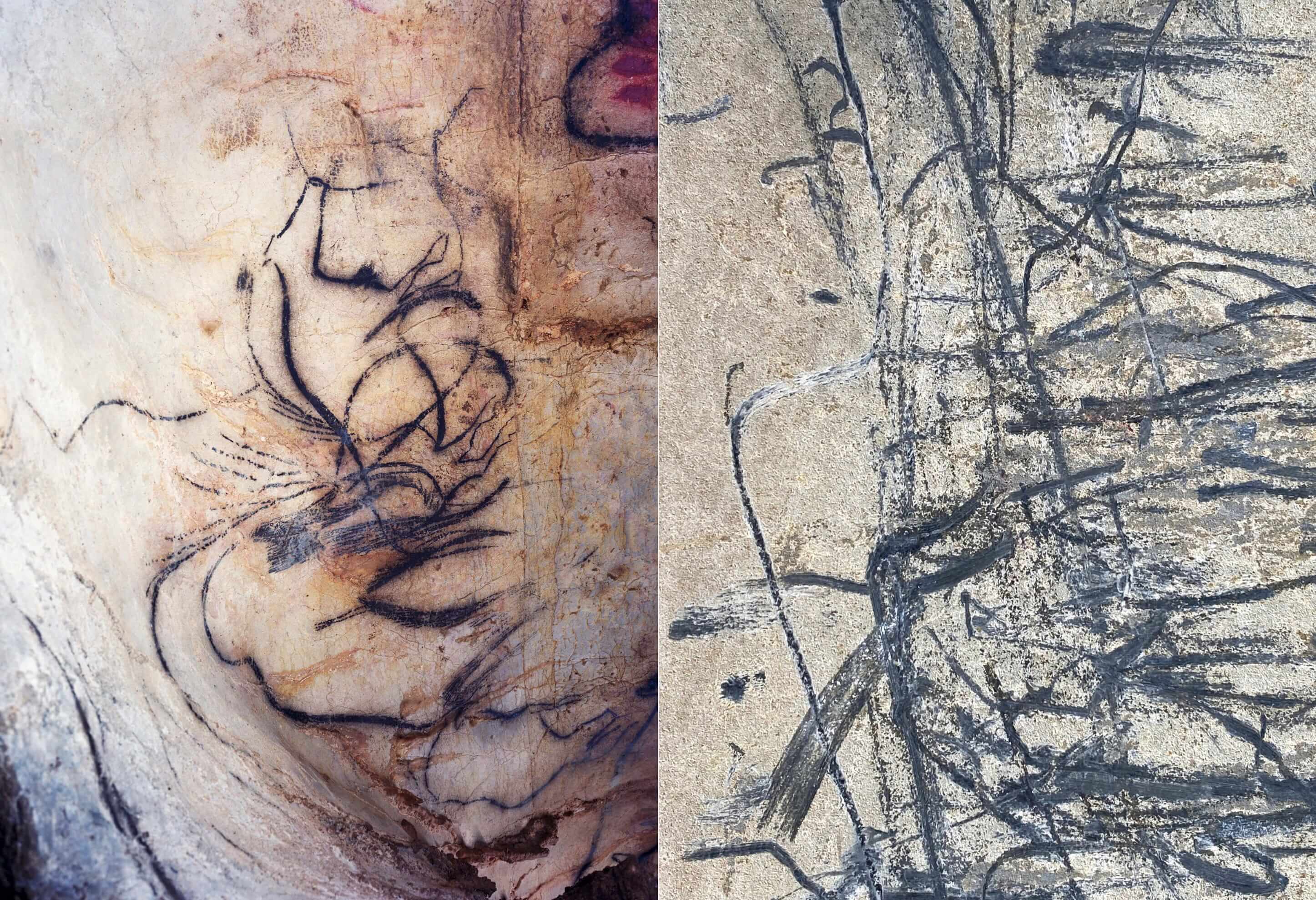
Future / Memories
Four hundred centuries of images meet, flickering through the dark, at the speed of light, from the first human marks of the Upper Palaeolithic to contemporary digitality. Following these parallel lines of questions and research, the work of Milella on the unforgotten and the abstract places us before a great mystery. Why images? How many? Which ones? What will become of our imagination? Here, for both curator and artist, photography seems to be a technical means to travel in space and time. Illegible origins encounter our difficulty to see the present and imagine the future.

Francesto Zanot: You started taking photographs in caves in 2015. From that point on, for a long time you went looking for the traces humans had left on the bare walls of these hidden places over many thousands of years. You went from the bright light of the images you’d been taking up to then, in Italy, Egypt, Greece, Turkey and Mexico, and many other countries around the world, to the darkness you encounter when you go down into the belly of the earth. How did you deal with this passage from light to shade, light to dark, sunlight to its total opposite? In Danny Boyle’s film Sunshine, at a certain point the psychiatrist who’s on the spaceship where the whole story takes place says: “And the point about darkness is, you float in it. You and the darkness are distinct from each other because darkness is an absence of something, it’s a vacuum. But total light, it envelops you. It becomes you.”
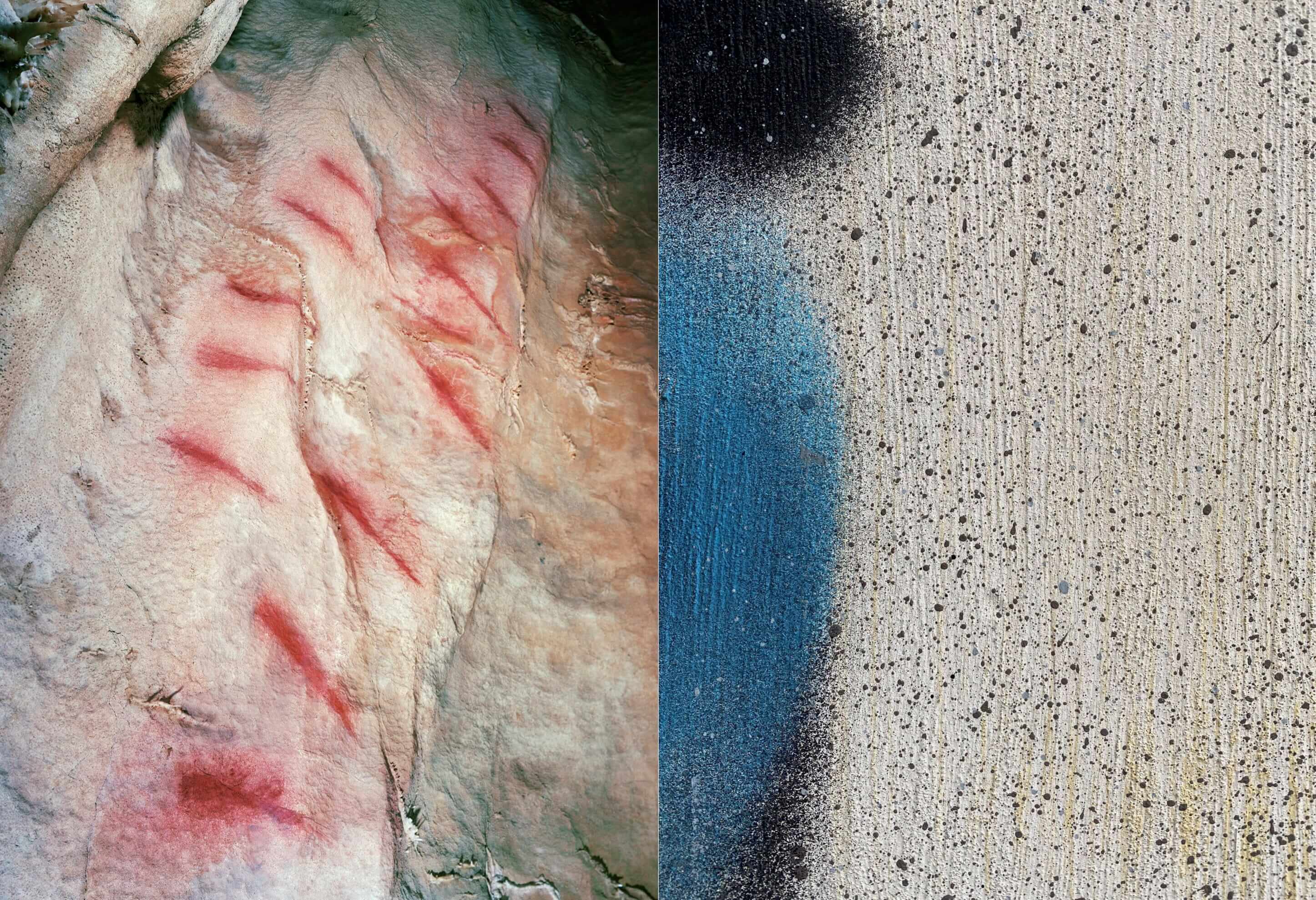
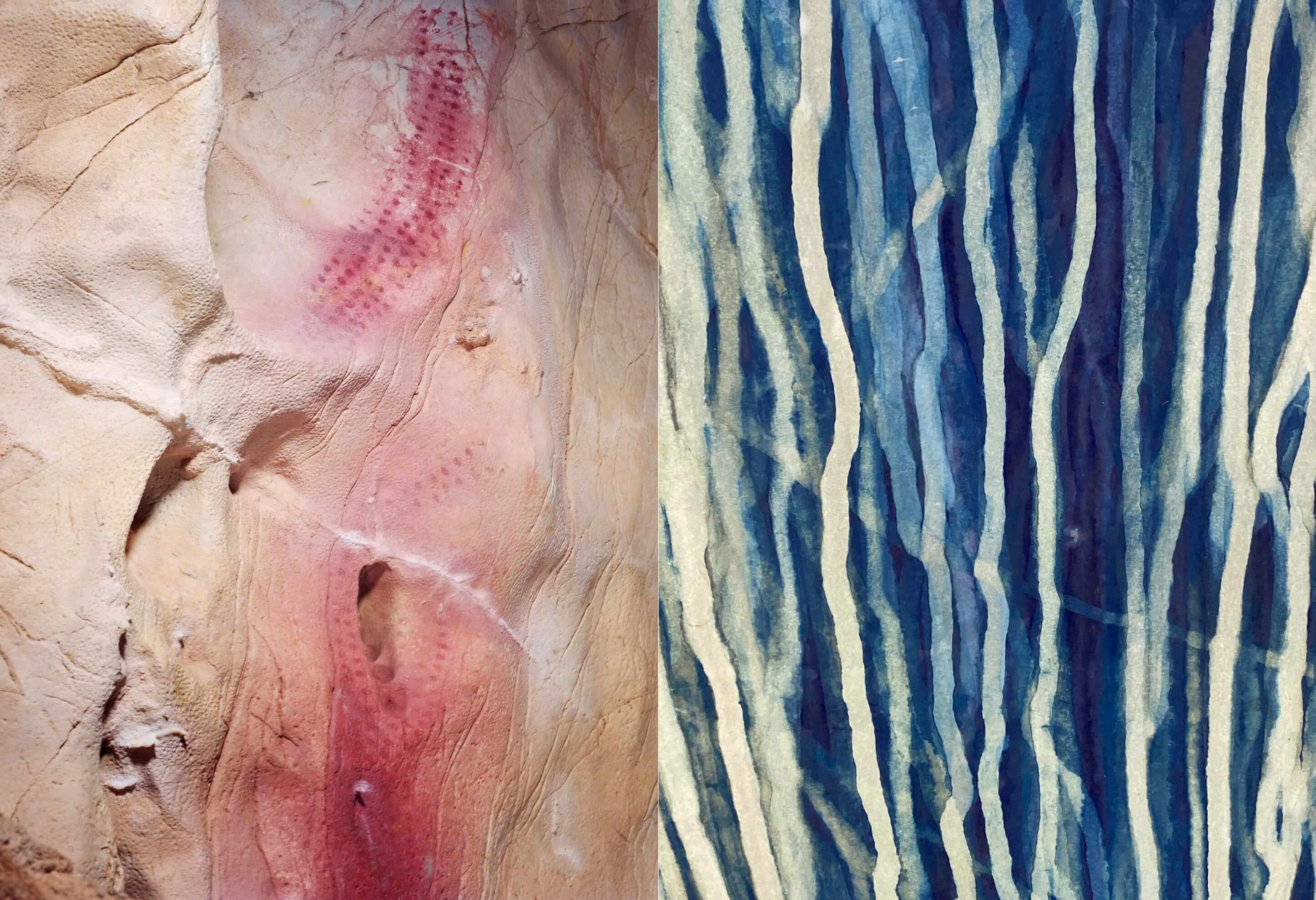
Domingo Milella: A few years into my artistic career, when I was 33, I fell into a deep depression. I collapsed. That sinking feeling is what drew me into caves. I don’t think I really chose prehistory and where it all began. Let’s just say I needed it. The first time they saw me set up my 20x25cm view camera in a dark, muddy painted cave, they thought I was mad. Working in the bowels of the earth is tough. There can be massive, pitch-black chambers, or such narrow spaces you have to work with your face pressed up against the rock. Caves are frightening, but welcoming at the same time. I think taking the view camera into the dark turned on a light in me. The great digital conflagration and the questions it raises drove me to look for the earliest images. Analogue photography requires darkness and water, silver and mineral images… all said, Cave, Eye, Camera Obscura and Human Mind are not so far apart. After seeing this research, a student recently said: “there’s no distance in the dark”.
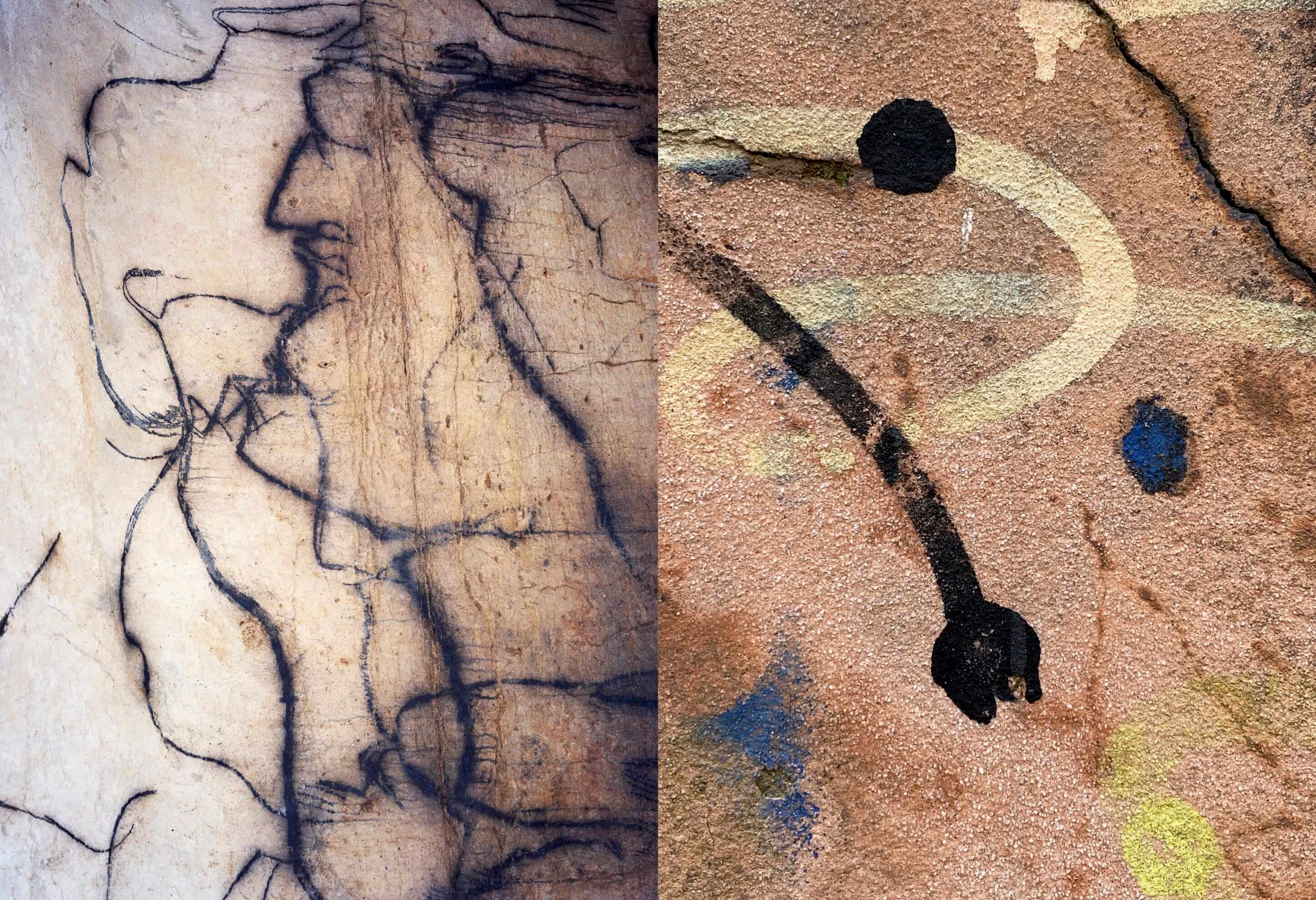
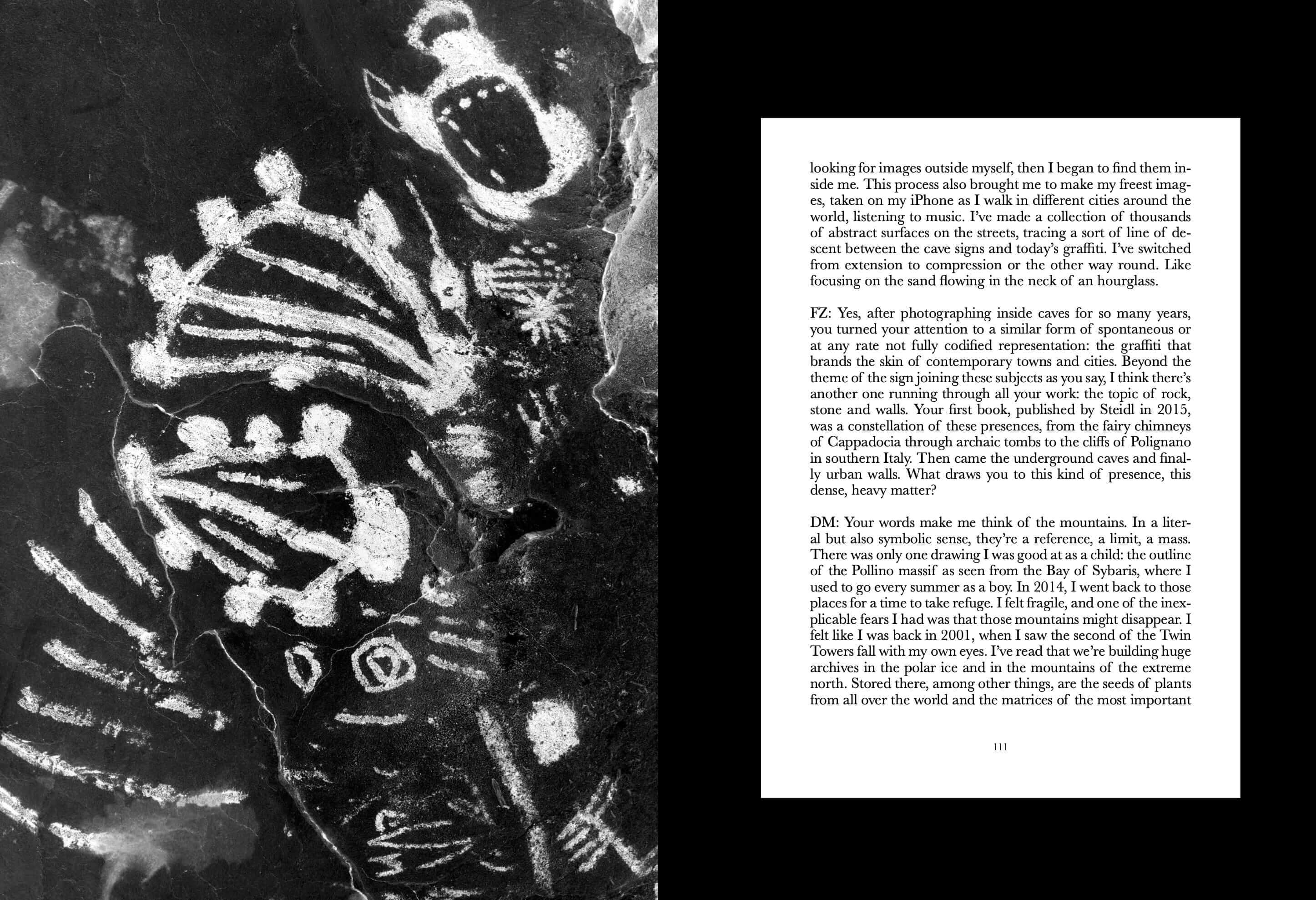
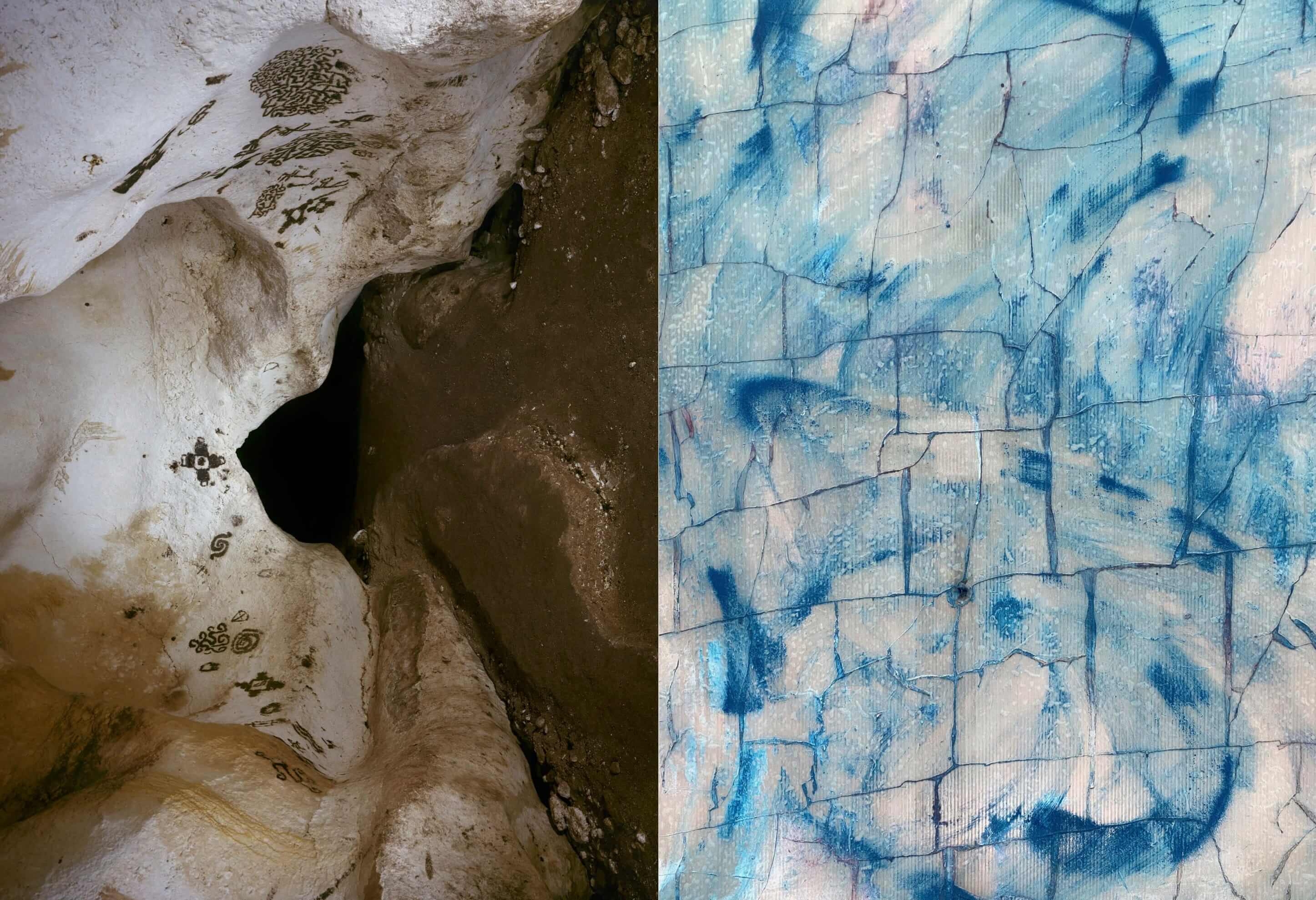
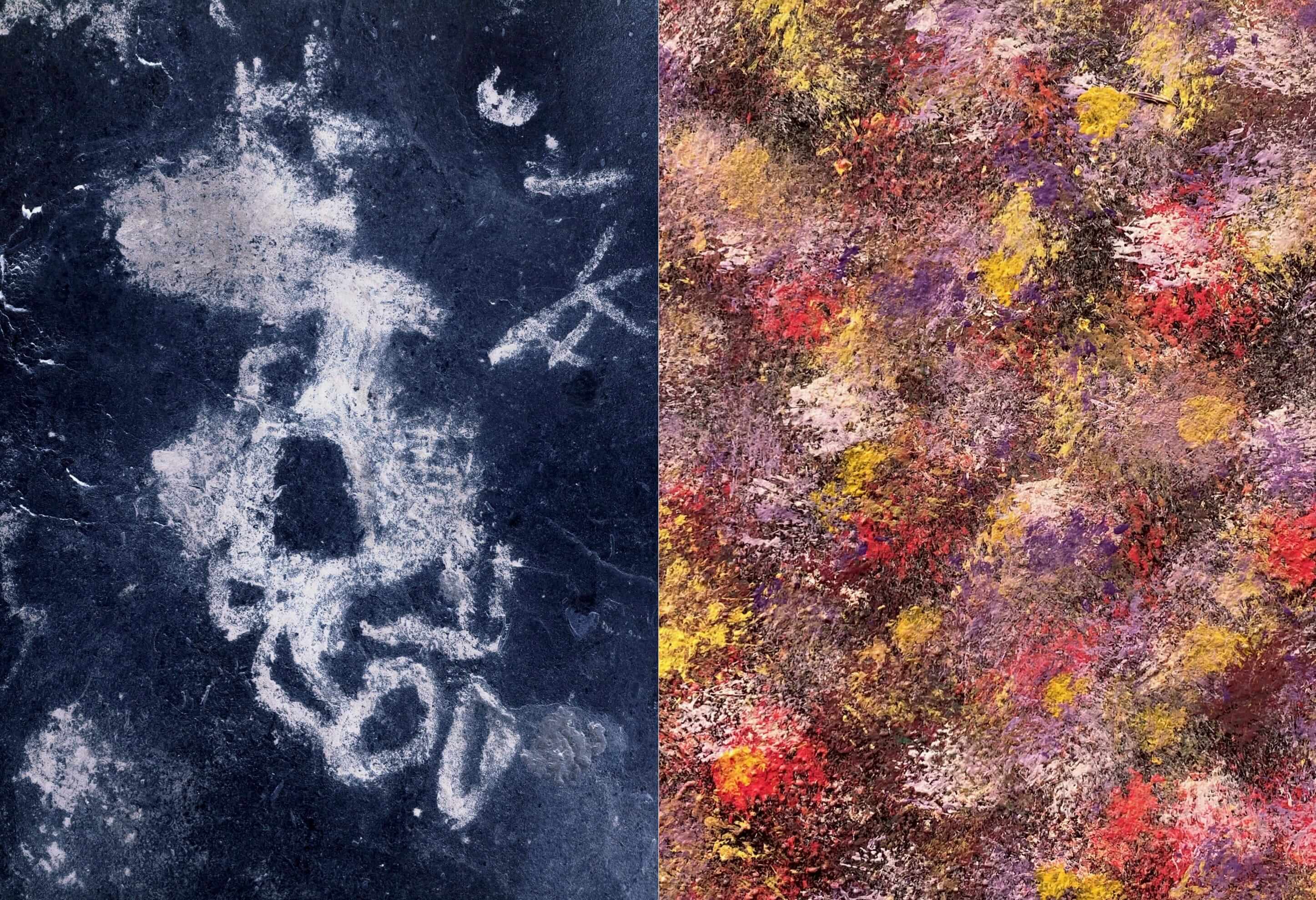
FZ: The works you made inside these caves aren’t just about the past. In fact, there’s something timeless about the graffiti at the centre of your images. Although they were made long, long ago, they often look like abstract works of contemporary painters, or even seem to belong to future artists yet to be born. Time is compressed until it almost disappears. This work of yours somehow makes us feel suspended, in a magical, irrational way. It dispels the tension arising from awareness of the inexorable passage of minutes, hours, years and geological eras. We are out of time.
DM: “OUTATIME” is what the licence plate of the DeLorean, the time machine in Back to the Future, reads. Travelling into the past alters the present, it changes the future… I think all art has always been an attempt to relate visible and invisible. I’m very interested in this escaping from the present, veering outside trends, to go in search of the universal. Going back to your first question, I don’t believe there’s any place on earth as dark as caves. The secret art hidden by our brothers and sisters 400 centuries ago has a connection to the eternal. Only outer space, far from the stars, is as dark as the belly of the earth, as our closed eyes, as our mind when we’re asleep. Recently I read that we don’t know much about dreams, even about our brains, and about the origins of art: nothing. We can’t really make out the depths of the sea, either. We’re so busy with algorithms, AI, screens, but we know very little about the geometric signs of early art. Yet for the people who made them, they must have been signals for the future. What are we cooking up for tomorrow’s world?
FZ: Yes, there are no certainties as to the meaning of many of the drawings found inside these caves, just some hypotheses. In our day and age, this is bordering on the unacceptable. We live in an age when everything has to have an explanation, and it sounds somewhat paradoxical to think that there are still such ancient, simple inscriptions we still can’t decipher. So, when we look at these signs, they make us feel lost, but also free. You spoke of the invisible, the universal. These terms are related to the unknown, or unknowable, which seems to me one of the threads that has always run through your work right from the start. Am I right? Are you using a tool like photography, based on a technical-scientific framework, to point out the flaws at the basis of this same paradigm?
DM: I think my first reason for using photography was as a form of extraction. At first with photography, art of the “here and now”, I was trying to expand time… Then this extraction became excavation, and I was the one who ended up falling into the hole that was being dug, a black, interstellar well of multiple connections. It was in this journey that I discovered abstraction. I like to call it astraction: star action. First I was looking for images outside myself, then I began to find them inside me. This process also brought me to make my freest images, taken on my iPhone as I walk in different cities around the world, listening to music. I’ve made a collection of thousands of abstract surfaces on the streets, tracing a sort of line of descent between the cave signs and today’s graffiti. I’ve switched from extension to compression or the other way round. Like focusing on the sand flowing in the neck of an hourglass.
FZ: Yes, after photographing inside caves for so many years, you turned your attention to a similar form of spontaneous or at any rate not fully codified representation: the graffiti that brands the skin of contemporary towns and cities. Beyond the theme of the sign joining these subjects as you say, I think there’s another one running through all your work: the topic of rock, stone and walls. Your first book, published by Steidl in 2015, was a constellation of these presences, from the fairy chimneys of Cappadocia through archaic tombs to the cliffs of Polignano in southern Italy. Then came the underground caves and finally urban walls. What draws you to this kind of presence, this dense, heavy matter?
DM: Your words make me think of the mountains. In a literal but also symbolic sense, they’re a reference, a limit, a mass. There was only one drawing I was good at as a child: the outline of the Pollino massif as seen from the Bay of Sybaris, where I used to go every summer as a boy. In 2014, I went back to those places for a time to take refuge. I felt fragile, and one of the inexplicable fears I had was that those mountains might disappear. I felt like I was back in 2001, when I saw the second of the Twin Towers fall with my own eyes. I’ve read that we’re building huge archives in the polar ice and in the mountains of the extreme north. Stored there, among other things, are the seeds of plants from all over the world and the matrices of the most important documents, to protect them from any cataclysms, revolutions or epidemics that might befall them. To protect them from ourselves? I think my work is a reaction to this. In the end, stone is a sort of memory of cosmic time. My photography seeks the immemorial.
FZ: This talk of the secrets and mixture of reality and abstraction at the basis of your work, particularly in recent years, reminds me of a phrase by David Lynch: “Life is filled with abstractions”. It seems to perfectly sum up our day-to-day relationship with everything we don’t know, don’t you think?
DM: The first tape I bought when I was a kid was just that: the Twin Peaks soundtrack. I adored the theme song. I think abstract thinking, one of the faculties that makes us human, is a way we have to shape the shapeless, pare down the unknown. Perhaps this was the function of the big animals painted in the dark in the caves, and of the altarpieces, big mosaics, cinema and influencers who are today’s priests of a kind of portable, electric religion. What is the backward-talking little Man from Another Place in Twin Peaks trying to tell us? Most of the art and knowledge we can enjoy today have to do with death in some way. I read a very nice piece by James Hillman recently. It seems that dreams are somehow tools to connect with the deep, but also to imagine the future, to face death. It seems that the parts of the brain that produce images while we sleep also generate a special alchemy between past and future: future memories in sleep and dreams. When it comes down to it, foreseeing means not only looking forwards, but also back, in time, space and inside ourselves…